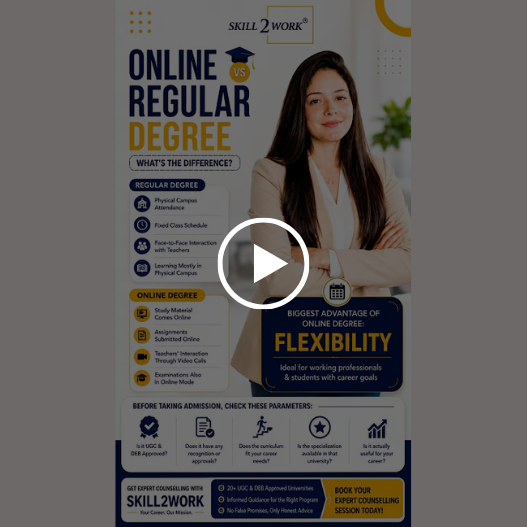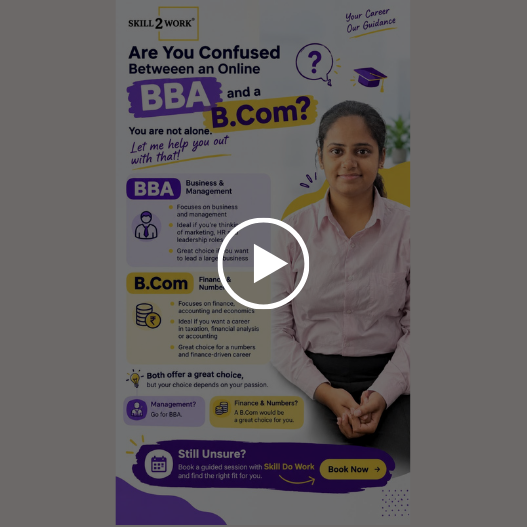
Get an Online M.Com degree to build skills in finance and accounting without leaving your job. Programs use video classes and online tests for easy learning.

An online M.Com, or Master of Commerce, is a postgraduate program completed online. It focuses on corporate finance, strategic management, accounting, and business analytics. This builds expertise for graduates in commerce.
M.Com distance learning fits working professionals. Top universities provide video lectures, assessments, forums, and digital tools. Learn from any location with ease.
After a bachelor’s, distance learning M.Com improves career options in finance and management. This format is gaining popularity in India as it supports earning while studying.
Programs stress practical skills in business organization, management strategies, teamwork, and entrepreneurship.

An online M.Com allows students to access lectures and study material from anywhere. This flexibility helps learners manage studies alongside work or other commitments.

M.Com online degree provides a self-paced learning environment, allowing students to progress through the material at a comfortable speed. This flexibility accommodates individual learning styles and preferences.

An online M.Com degree empowers students to balance their personal and professional lives while pursuing higher education. This integration promotes a healthy work-life-learning equilibrium.

Online programs can be more cost-effective, eliminating the need for relocation or commuting expenses. Additionally, online students may have access to digital resources, reducing the need for physical textbooks.

Working professionals can pursue a distance learning M.Com without having to leave their jobs. This allows them to apply theoretical knowledge directly to their work, creating a seamless integration of education and practical experience.

hrough virtual classrooms and international collaborations, M.Com distance learning programs expose students to a global perspective. This is particularly valuable in today's interconnected business world, where cross-cultural understanding is essential.

Online platforms facilitate interaction with a diverse group of students from around the world. This exposure to different perspectives and experiences enhances the overall learning environment.

The online learning environment naturally cultivates digital literacy and proficiency, essential skills in today's technology-driven workplaces. Students become adept at utilizing various online tools, contributing to their overall professional development.

M.Com graduates pursue roles in accounting, where they can work as accountants, auditors, or even become chartered accountants after obtaining relevant professional qualifications.

M.Com graduates specializing in taxation can work as tax consultants, advising individuals and businesses on tax-related matters, ensuring compliance with tax laws, and optimizing tax strategies.

M.Com graduates work as internal or external auditors, evaluating financial records, ensuring compliance, and providing recommendations for improvement.

Analyzing financial data, preparing reports, and providing insights for decision-making are common responsibilities for M.Com graduates in financial analyst roles.

Comprehensive grounding in commerce, accounting, finance, economics, and management. Develop broad-based skills suited for careers across corporate functions, entrepreneurship, academics, and public-sector roles.

Advanced financial accounting, reporting, taxation, audit, and corporate finance. Gain strong analytical and compliance capabilities to work in auditing firms, corporate finance teams, and financial advisory roles.

Focus on global financial systems, cross-border investments, currency risk, and international reporting standards. The ACCA-linked curriculum enhances employability for multinational organizations and global finance careers.

Study digital disruption in finance: blockchain, digital payments, AI-driven banking, and regulatory technology. Prepare for emerging roles across digital banking, fintech startups, and financial innovation units.

Focuses on AI applications in financial analysis, risk assessment, forecasting, and automated financial systems.

Helps learners integrate AI technologies into long-term business planning and competitive strategy.

Covers AI-based talent acquisition, workforce analytics, employee engagement, and HR automation.

Focuses on aviation operations, airport planning, airline management, and aviation regulations.

Emphasis on capital budgeting, valuation, risk management, working capital, and corporate strategy. Build decision-making skills to manage organizational finances and drive sustainable business growth.
Low Cost EMI Available
The fee structure for the online M.Com program is designed to support learners pursuing postgraduate education through flexible learning formats. Universities offering the online M.Com degree follow structured academic payment models that align with semester-based learning.
Fee components are defined by the institution and may include academic instruction, examinations, and digital learning resources. Exact fee amounts are communicated during the admission process.

| University | Specializations | Fee (Per Semester) |
|---|---|---|
| Manipal University Jaipur |
| INR 27,000/- |
| Sikkim Manipal University |
| INR 18,750/- |
| Lovely Professional University |
| INR 25,000/- |
| Kurukshetra University |
| INR 15,000/- |
| Jain University |
|
INR 27,500/- INR 30,000/- |
| Amity University |
|
INR 30,000/- INR 30,000/- |

Fee structure (may vary)

Fee structure (may vary)
Fee structure (may vary)

Fee structure (may vary)





Connect with Skill2Work mentors who help you make confident learning decisions.


Degrees earned through Online M.Com or distance learning are valid when the university or a deemed university is approved by UGC-DEB to offer the program. Information about approved institutions offering Online or distance mode courses is available on the official UGC website at https://deb.ugc.ac.in/
For more information, please contact us.
As per the UGC notification dated 02-09-2023, degrees obtained through online or distance mode are considered equivalent to regular degrees. Accordingly, an Online M.Com holds the same academic value and recognition as a regular M.Com. The official notification is available on the UGC website at https://deb.ugc.ac.in/Uploads/Notices_Upload/UGC_20220906101709_1.pdf
The Accreditations or Approvals required by Indian Universities to start online and distance learning programs are:
University Grants Commission (UGC) Approval: Indian universities, whether traditional or open, need to obtain approval from the UGC to offer online courses. The UGC had issued specific regulations for open and distance learning, which also apply to online education. These regulations specified the norms and standards that institutions had to adhere to while offering online programs.
Compliance with Distance Education Regulations: In addition to UGC regulations, universities offering online programs also had to comply with the Distance Education Bureau (DEB) regulations, which governed open and distance learning programs.
Approval from AICTE: The AICTE primarily focuses on technical education, including engineering, management, pharmacy, or applied sciences, and Indian Universities specifically do not require AICTE approval to start online courses. Its role is to regulate and promote technical education in India. These regulations are mainly applied to traditional universities and institutions that offer online or distance education programs.
Quality Assurance: Indian universities are required to maintain the quality and standards of education in online programs. This often involves regular assessment and accreditation by bodies like the National Board of Accreditation (NBA) or the National Assessment and Accreditation Council (NAAC).
Rankings: The National Institutional Ranking Framework (NIRF) is a ranking system for higher education institutions in India. It was launched by the Ministry of Education in 2015 to assess and rank Indian universities and colleges based on various parameters. NIRF rankings aim to provide prospective students and other stakeholders with valuable information about the quality and performance of educational institutions
An Online M.Com is well-suited for commerce graduates or learners from related disciplines who want to strengthen their knowledge in finance, accounting, and business management. It is also a practical option for working professionals seeking career growth without leaving their jobs, as well as for individuals looking for flexible and cost-effective learning opportunities.
After completing an Online M.Com, graduates can move into advanced roles across finance, accounting, and business management, including financial analyst, accountant, tax consultant, or auditor. Learners may also choose to pursue higher studies such as a Ph.D. in Commerce, professional certifications like CA or CFA, or explore teaching and academic careers in commerce and business disciplines.
Yes, an Online M.Com is a strong career choice as it builds advanced knowledge in finance, accounting, and business management, leading to opportunities across private and public sectors. Its flexible and cost-effective format makes it suitable for working professionals seeking career advancement and specialization in commerce-related fields.
After completing an Online M.Com, graduates can explore career opportunities across finance, accounting, banking, and business management. Common roles include financial analyst, accountant, tax consultant, auditor, investment banker, and finance manager. The degree also supports careers in business strategy, operations, management consulting, teaching, research, and government roles, making it a flexible option for long-term career growth in commerce-related fields.
The Online M.Com program has a standard duration of two years, with the flexibility to complete all requirements within a maximum period of four years.
Online education for an Online M.Com may include live classes through video conferencing or webinars, depending on the university and program structure. Some courses offer interactive live sessions with faculty, while others follow a self-paced model using recorded lectures. Since formats vary, students should review course details to understand whether live classes are included.
Distance M.Com and Online M.Com both offer flexible ways to earn a Master of Commerce degree, but they differ in delivery. Distance M.Com usually follows a self-study model with printed or downloadable materials and limited interaction. In contrast, Online M.Com provides interactive learning through digital platforms, including live classes, virtual classrooms, online discussions, and instant access to resources, creating a more engaging and accessible learning experience.