
The Online MA in economics is a postgraduate course of study for those students who want to enhance their knowledge in terms of economic theories and policies without compromising their regular job or other essential interests.

By registering for the MA economics online programme, students can learn and acquire the respected MA degree while managing their regular jobs, competitive exams, and personal activities too. The programme has been developed to provide students with solid grounds in subjects such as microeconomics, macroeconomics, econometrics, public economics, and international trade.
Particularly suits individuals who wish to pursue a role in policy analysis, financial analysis, academia, or perhaps an international organisation. The online course structure will enable independent learning while at the same time guiding the students academically. This will enable individuals to easily participate in balancing their learning with their professional obligations.
With the demand for economists in finance, public policy, research, and international institutions thriving, an Economics master’s degree online from top-notch universities brings credibility and convenience. The course covers areas of analytical thinking, economic modeling, and applied economics that prepare learners for different career paths.

Study anytime, anywhere with online access to lectures, learning resources, and assessments.

Gain advanced economic knowledge that supports growth in finance, policy, research, and analytics roles.

Develop strong analytical and research skills through data interpretation, economic modelling, and applied studies.

An online master’s degree is more affordable than regular programmes while offering comparable academic rigour through structured online delivery.

UGC-approved institutions ensure nationwide acceptance and academic credibility.

Build critical thinking, quantitative analysis, problem-solving, and policy evaluation skills.

Useful for students preparing for UPSC, State PSCs, PhD programmes, or teaching careers.

The curriculum aligns with international economic trends, making it suitable for global career aspirations.

Economic analysts study market trends, economic indicators, and data patterns to support policy and business decisions.

Work with government bodies, think tanks, or NGOs to design, analyse, and evaluate public policies.

Apply economic principles to financial planning, investment strategies, and risk assessment.

Analyse consumer behaviour, market demand, and industry trends using economic and statistical tools.

Support investment decisions through macroeconomic analysis and forecasting.

Pursue teaching or research roles, or continue towards a PhD in economics or allied disciplines.

Opportunities in global institutions focusing on trade, development economics, and public policy.

Emphasizing literature, linguistics, critical theory, and advanced communication skills.

Encompasses historical analysis, cultural studies, and research-based understanding of past societies.

Analyses the structures and behaviour of society by studying perspectives.

Focuses on political theory, governance, public administration, and international relations.

Focuses on AI applications in financial analysis, risk assessment, forecasting, and automated financial systems.

Helps learners integrate AI technologies into long-term business planning and competitive strategy.

Covers AI-based talent acquisition, workforce analytics, employee engagement, and HR automation.

Focuses on aviation operations, airport planning, airline management, and aviation regulations.

Enhances knowledge and understanding of economic theories and policy, and socio-economic developments.

Develops skills in media studies, communication theory

Focuses on policy frameworks, governance, and administrative systems.

Focuses on policy formulation, governance processes, and public administration systems.

Explores human behaviour, mental processes, and psychological theories.

Examines social structures, institutions, and patterns of human interaction.

Studies Jain philosophy alongside comparative religious and philosophical traditions.

Develops understanding of media practices, communication theory, and content creation.
Low Cost EMI Available
The Online MA courses have a low-cost structure that is highly transparent, and the courses offer a variety of payment systems according to the financial needs of the learners. EMI systems also make it easier to pay the tuition fees.

| University | Fee Structure |
|---|---|
| Chandigarh University | ₹18,750 per semester |
| Manipal University Jaipur | ₹20,000 per semester |
| Jain University | ₹22,500 per semester |


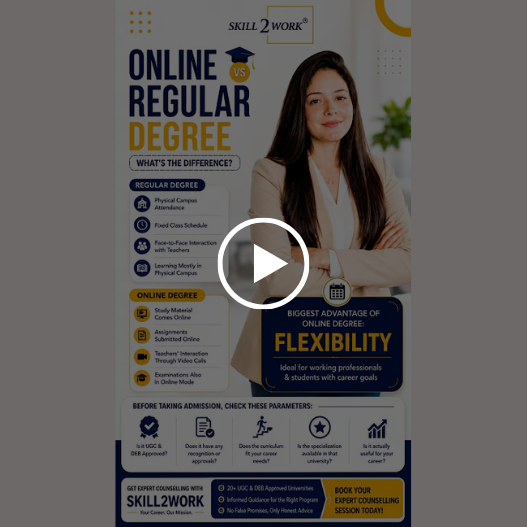
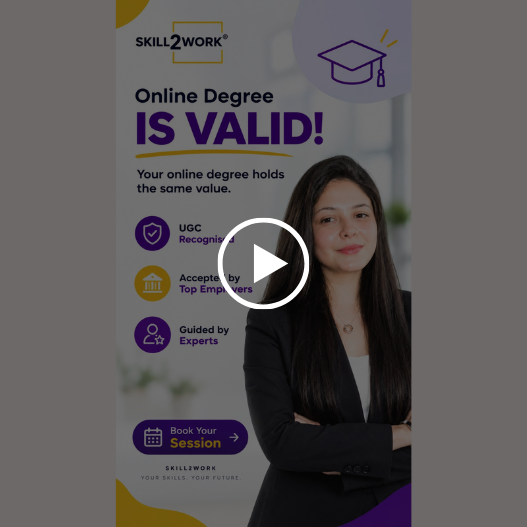
Yes, degrees earned through online or distance mode are valid as long as the university is approved by UGC-DEB to offer the programme. The official list of approved universities is available on the UGC-DEB website. Details of the Universities/ Deemed to be Universities empowered to offer courses under Online/distance mode are available at UGC website https://deb.ugc.ac.in/.
Yes, as per UGC guidelines, degrees awarded through online or distance learning are considered equivalent to regular degrees, provided they are offered by approved institutions.
The Accreditations or Approvals required by Indian Universities to start Online and distance learning programs are: –
Rankings: The National Institutional Ranking Framework (NIRF) was introduced by the Ministry of Education in 2015 to evaluate and rank Indian universities and colleges. Rankings are based on multiple criteria like teaching, learning resources, research, and overall performance. NIRF rankings help students and stakeholders make informed decisions about the quality and reputation of higher education institutions.
This programme is ideal for working professionals, aspiring economists, policy enthusiasts, government employees, entrepreneurs, and students seeking flexible learning while building strong expertise in economics.
Graduates can explore careers in research, finance, public policy, consulting, government services, international organisations, or continue with a PhD for academic and research-oriented roles.
Yes, it is a strong career choice for those looking to gain advanced economic knowledge with flexibility. The programme opens doors to diverse roles across finance, policy, analytics, academia, and global trade.
Career options include economic analyst, policy advisor, financial consultant, market researcher, investment strategist, academician, and roles in government agencies or international organisations.
The standard duration is 2 years, with flexibility to complete the programme within a maximum of 4 years.

The fee typically ranges between ₹18,750 and ₹22,500 per semester, depending on the university and payment plan selected.

Some universities offer live interactive sessions, while others provide recorded lectures. The learning format varies by institution, so it’s best to check individual course details before enrolling.