
Generic selectors
Exact matches only
Search in title
Search in content
Post Type Selectors
Generic selectors
Exact matches only
Search in title
Search in content
Post Type Selectors

Dual MBA in Supply Chain
Production and Management

A Dual MBA in Supply Chain Production and Management is designed to build expertise in managing production systems, logistics, procurement, and overall supply chain operations. This program will enable the learner to develop skills to optimise processes and ensure smooth coordination between production and distribution networks.

Why Choose a Dual MBA in Supply Chain Production and Management?

A Dual MBA in Supply Chain Production and Management is the best fit for those who aim to develop high-quality operational and managerial skills in manufacturing and logistics operations. In the current competitive business scenario, businesses depend largely on effective supply chain management systems to cut down costs, minimize delivery times, and ensure quality.

This dual MBA program equips students with in-depth knowledge of production planning, inventory management, logistics management, procurement planning, quality management, and supply chain analytics. Students are taught how raw materials are converted into finished goods and distributed efficiently to customers through a properly planned supply chain.

The online program allows working professionals to upgrade their credentials without quitting their jobs. The course material includes both theoretical knowledge and practical applications in the form of case studies, projects, and industry tools.

A Dual MBA in Supply Chain Production and Management will benefit operations managers, production executives, logistics managers, entrepreneurs, and those who have ambitions to become leaders in the manufacturing and supply chain industry. This degree will enhance your decision-making capabilities and prepare you to tackle operational challenges with confidence.

An online Dual MBA in Supply Chain Production and Management will help you enhance your career while managing your personal and professional life.

Production Planning Skills

Learn to optimise production planning, capacity, and workflow.

Supply Chain Strategy

Develop skills to design effective supply chains and distribution networks.

Inventory Management

Learn to manage inventory, forecast, and minimise costs.

Logistics & Procurement Skills

Gain knowledge to source, manage suppliers, and plan transportation.

Quality Management

Learn to apply quality management and continuous improvement.

Operational Efficiency

Enhance process performance and resource management across industries.

Analytical Skills

Apply data analytics to improve supply chain performance.

Career Flexibility

Enhance your career to lead manufacturing, retail, e-commerce, and logistics businesses.

Eligibility & Duration

Dual MBA in Supply Chain Production and Management Eligibility
Candidates must hold a bachelor’s degree following the 10+2+3 education pattern in any discipline from a recognized university or an equivalent qualification approved by the Association of Indian Universities (AIU). A minimum of 50% marks at the graduation level is required, while candidates from SC, ST, OBC, or PwD categories are eligible with 45%.
Dual MBA in Supply Chain Production and Management Duration
The program runs for 2 years and is divided into 4 semesters, with a four-year validity period. The master’s degree focuses on production management, logistics systems, operations strategy, business analytics, and quality control. Its flexible structure allows learners to balance studies alongside their professional responsibilities while maintaining steady academic progress.

Most Common Career Opportunities After Completion

MBA Specialisations

Agri Business Management

Focuses on agricultural supply chains, agribusiness operations, rural marketing, and food industry management.

Artificial Intelligence & Machine Learning Management

Covers AI-driven decision-making, machine learning models, automation, and business intelligence applications.

AI for Business Management

Designed to help managers apply artificial intelligence tools to improve strategy, operations, and decision-making.

AI Marketing Management

Explores the use of AI in customer targeting, digital campaigns, data-driven marketing, and consumer insights.

Dual MBA Specialisations

Analytics & Data Science Management

Combines analytical techniques with data science tools to support data-driven business decisions.

Banking & Financial Services Management

Covers banking operations, financial markets, credit management, and financial regulations.

Banking Finance & Insurance Management

Focuses on banking systems, insurance operations, and integrated financial services.

Business Analytics Management

Combines analytics tools with managerial decision-making for strategic business insights.

Entrepreneurship & Leadership Management

Focuses on building entrepreneurial skills alongside leadership and people management.

Finance & Accounting Management

Covers financial management, accounting principles, auditing, and compliance.

Finance & Marketing Management

Combines financial analysis with marketing strategy and business growth planning.

Financial Services & Financial Planning Management

Focuses on wealth planning, financial advisory, investment strategies, and client management.

Hospital Administration & Healthcare Management

Integrates hospital operations with healthcare service management and policy planning.

HRM (Analytics) Management

Combines human resource management with data analytics for workforce planning.

HRM & Finance Management

Covers human capital management along with financial planning and cost control.

HR & Business Analytics Management

Focuses on applying analytics to HR decision-making and organizational performance.

International Finance & Accounting Management

Covers global accounting standards, international finance, and cross-border compliance.

IT & FinTech Management

Integrates information technology with financial technology applications.

Logistics & Supply Chain Management

Covers end-to-end supply chain operations, logistics planning, and distribution management.

Logistics Material & Supply Chain Management

Focuses on material management, procurement, logistics, and supply chain optimization.

Marketing & Human Resource Management

Combines marketing strategies with people management and organizational development.

Marketing & Business Analytics Management

Focuses on data-driven marketing strategies and performance analysis.

Operations & Supply Chain Management

Covers operations planning alongside supply chain coordination and efficiency.

Operations & Data Science Management

Combines operational decision-making with data science tools and analytics.

Production & Operations Management

Focuses on manufacturing systems, production planning, and operational efficiency.

Supply Chain Production & Management

Integrates production processes with supply chain planning and execution.

Fee Structure for Online Dual MBA in Supply Chain Production and Management

Program Fee: Starting at ₹ 49,000/- Per Semester

Low Cost EMI Available

The tuition structure for the Dual MBA in Supply Chain Production and Management program is designed to be affordable and flexible for online students. Since the program is online, students do not incur costs associated with travelling, staying in hotels, and accessing campus facilities. Tuition is paid semester by semester, making it convenient for students to budget. The tuition for the program covers online learning platforms, learning materials, faculty, online lectures, and online assessments.

Flexible Fee Payment Options Available for Students:

University Offering Online MBA in Supply Chain Production and Management

UniversityFees Structure
Jain University₹49,000/- per semester
Chandigarh University₹41,250/- per semester
Lovely Professional University₹50,000/- per semester

How Skill2Work Assists You

Expert Counseling

Course Comparison

Admission Support

Eligibility Guidance

Ongoing Assistance

The Right Path Begins with The right guidance

Connect with Skill2Work mentors who help you make confident learning decisions.

Our Testimonials

Quick Tips & Insights

Career Guidance for Students
Aiming Government Jobs
Build Job-Ready Skills & Get
Hired Faster
Smart Planning for Government Jobs
Career Advice

Need Assistance? Get In Touch

University Form

Frequently Asked Question

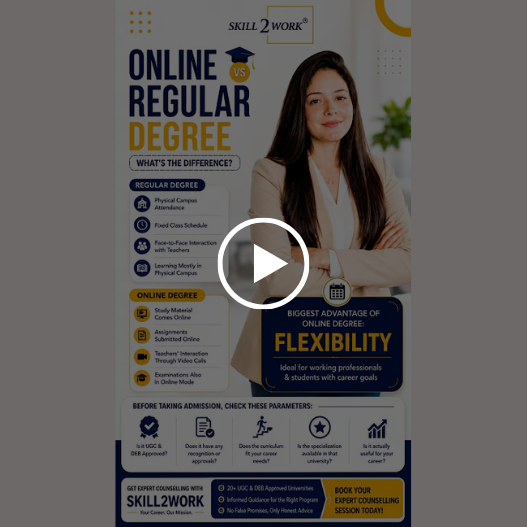
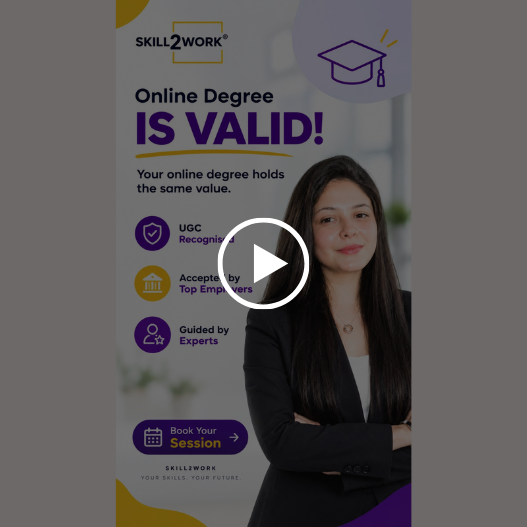
IS ONLINE DEGREE VALID?

Yes, degrees obtained through Online or Distance mode are valid as long as the university offering the programme is approved by the University Grants Commission through the Distance Education Bureau (UGC-DEB). Only universities that receive this approval are permitted to offer online or distance learning programmes. You can check the list of recognised universities on the UGC website: https://deb.ugc.ac.in/.  For more information, call us!

Yes, the UGC, through its notification dated 02-09-202,2 has clearly stated that any degree obtained through Online or Distance mode holds the same equivalence as a degree earned through regular mode.

This means an MBA completed through online or distance learning is recognised in the same way as a traditional MBA.

The official notification can be accessed here: https://deb.ugc.ac.in/Uploads/Notices_Upload/UGC_20220906101709_1.pdf.

The Accreditations or Approvals required by Indian Universities to start Online and distance learning programmes are: –

  • University Grants Commission (UGC) Approval: Indian universities, whether traditional or open universities, must obtain approval from the UGC to offer online courses. The UGC has issued specific regulations for open and distance learning which also apply to online education. These regulations define the standards and guidelines institutions must follow while offering online programmes.
  • Compliance with Distance Education Regulations: Along with UGC guidelines, universities providing online programmes must also comply with the regulations of the Distance Education Bureau (DEB), which governs open and distance learning programmes.
  • Approval from AICTE: The All India Council for Technical Education mainly focuses on technical education such as engineering, management, pharmacy, and applied sciences. Indian universities generally do not require AICTE approval to start online courses, as its regulations primarily apply to traditional technical institutions.
  • Quality Assurance: Indian universities are required to maintain strong academic standards in their online programmes. This often involves regular evaluation and accreditation from organisations like the National Assessment and Accreditation Council (NAAC).

Rankings: The National Institutional Ranking Framework (NIRF) is a ranking system for higher education institutions in India. Introduced by the Ministry of Education in 2015, it evaluates and ranks universities and colleges based on multiple performance parameters. NIRF rankings help students and stakeholders understand the overall quality and performance of institutions.

Individuals who wish to grow their careers in areas such as operations, manufacturing, procurement, and logistics should consider pursuing an MBA in Logistics and Supply Chain Management. This programme is particularly suitable for professionals looking to strengthen their strategic and managerial abilities in managing end-to-end supply chain operations. It is ideal for candidates from business, engineering, or similar academic backgrounds who want to specialise in improving efficiency, streamlining processes, and introducing innovative solutions within supply chain systems. The course is also beneficial for those aiming for leadership roles such as Supply Chain Managers, Operations Directors, or Consultants, and for professionals who want to play a key role in today’s fast-moving global business environment.

An MBA in Logistics and Supply Chain Management opens doors to a wide range of career opportunities across multiple industries. Graduates of this programme can pursue roles such as Supply Chain Manager, Procurement Manager, Purchasing Manager, Procurement Officer, Logistics Manager, Marketing Executive, ERP Consultant, Demand Planner, Supply Chain Analyst, Supply Chain Consultant, and Supply Chain Coordinator. This programme helps professionals develop expertise in supply chain operations and prepares them for responsible roles across different sectors.

The standard duration of the programme is 2 years. However, students are usually given flexibility and can complete the course within a maximum period of 4 years, depending on the university guidelines.

No, most universities offer admission to this programme based on eligibility criteria and by evaluating the candidate’s application. Therefore, students generally do not need to appear for any entrance examination to enrol in this course.

The fee structure for this programme varies depending on the university offering it. For example, the semester fee at JAIN University is ₹49,000 per semester, while Chandigarh University charges ₹41,250 per semester. Similarly, Lovely Professional University has a semester fee of ₹50,000. Many universities also provide flexible payment options such as EMI facilities, allowing students to pay their course fees in instalments throughout the duration of the programme.