
The Online MA in English helps students delve into literature, language, and critical thinking in a flexible learning environment. The online MA English course includes poetry, drama, fiction, linguistics, and literary theory. By pursuing an English literature online course, students develop excellent research, writing, and analytical skills to pursue a career in education, media, publishing, and academia.

Online MA in English is perfect for those who are interested in literature, language, and communication. The course will enable students to examine various literary traditions, critical theories, and contemporary approaches to literature, as well as develop strong analytical and writing skills.
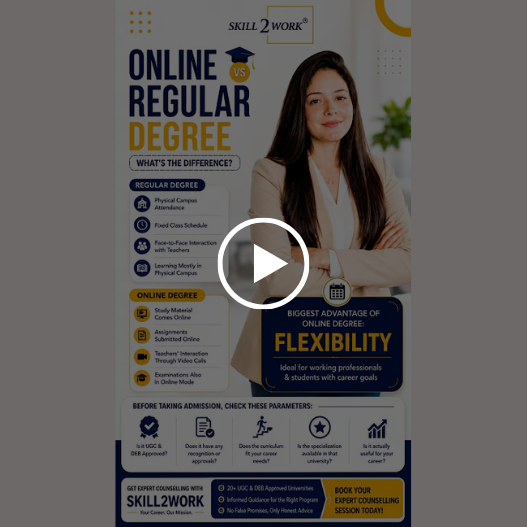
The online MA English literature course gives learners in-depth knowledge of classical and contemporary literature, literary criticism, and language studies. Students examine various works of literature from different cultures and eras while developing skills to interpret and analyze literary texts. One of the major benefits of doing an English master’s degree online is flexibility. Students and working professionals can pursue their careers while simultaneously acquiring their academic qualifications through online learning platforms, recorded lectures, and online classes.
The online MA English course also fosters research, interpretation, and critical discourse. Through various assignments, literary analysis, and research work, students enhance their academic abilities and develop a deeper appreciation of literature. The course is ideal for those who want to become teachers, writers, editors, researchers, journalists, and professionals in language, communication, and literature.

Study major literary works, genres, and literary movements.

Develop critical thinking and interpretation abilities through literature.

Improve academic writing, research, and textual analysis.

Explore global literary traditions and cultural perspectives.

Study through an English literature online course while continuing professional work.

Prepare for careers in teaching, publishing, journalism, and research.

Strengthen language proficiency and professional communication.

Build a strong foundation for further studies and research in literature.

Teach literature and language at schools or colleges.

Create written content for digital platforms, media, and organizations.

Edit books, articles, and academic publications.

Work in the news, publishing, and media industries.

Conduct literary and academic research in universities or institutions.

Work with publishing houses in editorial and production roles.

Manage communication strategies in organizations.

Provide guidance in literature and language studies.

Emphasizing literature, linguistics, critical theory, and advanced communication skills.

Encompasses historical analysis, cultural studies, and research-based understanding of past societies.

Analyses the structures and behaviour of society by studying perspectives.

Focuses on political theory, governance, public administration, and international relations.

Focuses on AI applications in financial analysis, risk assessment, forecasting, and automated financial systems.

Helps learners integrate AI technologies into long-term business planning and competitive strategy.

Covers AI-based talent acquisition, workforce analytics, employee engagement, and HR automation.

Focuses on aviation operations, airport planning, airline management, and aviation regulations.

Enhances knowledge and understanding of economic theories and policy, and socio-economic developments.

Develops skills in media studies, communication theory

Focuses on policy frameworks, governance, and administrative systems.

Focuses on policy formulation, governance processes, and public administration systems.

Explores human behaviour, mental processes, and psychological theories.

Examines social structures, institutions, and patterns of human interaction.

Studies Jain philosophy alongside comparative religious and philosophical traditions.

Develops understanding of media practices, communication theory, and content creation.
Low Cost EMI Available
The fee structure for the online MA English course is designed in such a way that it makes higher education more accessible to students. Since it is an online course, students can opt for this course without having to pay extra fees for traveling, moving, or staying in the campus hostel. The fee structure is also semester-wise, which makes it easier for the students to manage their expenses. The fee structure includes online learning platforms, study materials, faculty support, recorded lectures, and live classes.

| University | Fee Structure |
|---|---|
| Sikkim Manipal University | ₹18,750 per semester |
| Lovely Professional University | ₹20,000 per semester |
| Chandigarh University | ₹18,750 per semester |
| Kurukshetra University | ₹15,000 per semester |
| Vivekananda Global University | ₹18,000 per semester |
| Jain University | ₹22,500 per semester |

₹23,334/- per semester
Fee structure (may vary)

₹22,500/- per semester
Fee structure (may vary)


₹20,000/- per semester
Fee structure (may vary)

₹30,000/- per semester
Fee structure (may vary)

₹25,000/- per semester
Fee structure (may vary)


Yes, degrees obtained through Online or Distance mode are valid as long as the university or deemed university offering the programme has approval from UGC-DEB. Information about universities authorised to offer programmes in online or distance mode can be found on the UGC website: https://deb.ugc.ac.in/.
Yes. According to the UGC notification dated 02-09-2023, any degree obtained through Online or Distance mode is considered equivalent to a degree earned through regular mode. The official notification can be accessed here: https://deb.ugc.ac.in/Uploads/Notices_Upload/UGC_20220906101709_1.pdf.
Therefore, an MA completed through Online or Distance mode holds the same recognition as a regular MA.
The accreditations or approvals required by Indian universities to offer online and distance learning programs are:
University Grants Commission (UGC) Approval: Indian universities, whether conventional or open, must obtain approval from the UGC to offer online programmes. The UGC has issued regulations for open and distance learning that also apply to online education. These regulations outline the standards and norms institutions must follow while offering online programs.
Compliance with Distance Education Regulations: Apart from UGC guidelines, universities offering online programs must also comply with the regulations of the Distance Education Bureau (DEB), which governs open and distance learning programmes.
Approval from AICTE: AICTE mainly regulates technical education such as engineering, management, pharmacy, and applied sciences. Indian universities generally do not require AICTE approval specifically to start online courses. AICTE’s role is to regulate and promote technical education in India, mainly in traditional institutions.
Quality Assurance: Universities in India are expected to maintain educational standards and quality in their online programs. This is often ensured through evaluation and accreditation by organisations like the National Assessment and Accreditation Council (NAAC).
Rankings: The National Institutional Ranking Framework (NIRF) is a ranking system introduced by the Ministry of Education in 2015. It evaluates and ranks higher education institutions in India based on several parameters, helping students understand the performance and quality of universities.
An Online MA in English is suitable for individuals who have a strong interest in literature and language. It is ideal for aspiring teachers, writers, content creators, communication professionals, linguistics enthusiasts, competitive exam candidates, working professionals looking to grow in their careers, and anyone passionate about English studies.
After completing an Online MA in English, graduates can explore multiple career options. They may work in the education sector as teachers or academic researchers. Opportunities are also available in publishing, content writing, editing, media, and communication roles such as content strategists or PR professionals. Some graduates also pursue careers in creative writing, storytelling, or corporate communication. The degree helps develop strong analytical and language skills that are useful in many professional fields.


Yes, an Online MA in English can be a valuable career option for individuals interested in literature, language, and communication. The programme offers flexibility, allowing working professionals to study while continuing their careers. With a recognised qualification, graduates can explore roles in education, publishing, media, content creation, and corporate communication. The course also strengthens writing, research, and analytical abilities, making it a versatile qualification for various industries.
After completing an Online MA in English, graduates can find job opportunities in several sectors. In education, they may work as teachers, lecturers, or researchers. In media and publishing, roles include content writer, editor, journalist, or copywriter. They may also work in corporate communication as public relations specialists or communication managers. Other career paths include digital content creation, advertising, media planning, creative writing, screenwriting, and publishing. The skills gained during the programme also support careers in NGOs, consulting, and content strategy.
The standard duration of the program is 2 years, although students usually have the flexibility to complete it within a maximum period of 4 years.
The cost of an Online MA is generally more affordable than traditional classroom-based MA programs. The fee typically ranges between INR 15,000 to INR 22,500 per semester, depending on the university or institution offering the course.
Online education may include live lectures conducted through video conferencing or webinars, depending on the specific program. Some online courses provide interactive live sessions with faculty members, while others offer pre-recorded lectures that students can access at their convenience. The exact format varies by institution, so it is recommended to review the course details to understand whether live lectures are included.